Exhibitions

Currently on View at Bainbridge House

EINSTEIN AT HOME

 Einstein sitting on the front steps
Photo Credit: Einstein sitting on the front steps of his home in Princeton, wearing his fuzzy slippers.
Photo courtesy of Gillett Griffin.

A Special Exhibition at the Historical Society of Princeton's Bainbridge House location

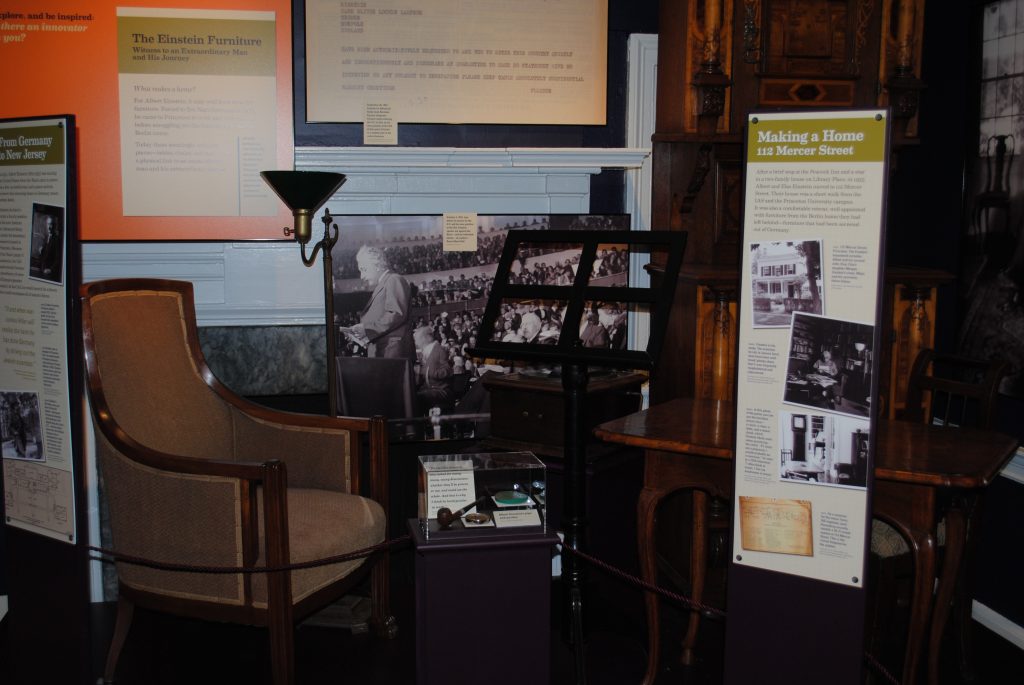
The Historical Society of Princeton is pleased to announce the opening of Einstein at Home, a special exhibition featuring selected pieces of furniture from the Einstein Collection of the Historical Society of Princeton. Through these rarely-seen objects, visitors will have the opportunity to glimpse the personal side of the world-famous scientist, Albert Einstein. Photographs and other memorabilia will tell the story of Einstein's life in Princeton, his home from 1933 until his death in 1955.

This exhibition will be on view from February 8, 2011 through August 19, 2012.

Admission is $4 but is free for members of HSP.

The Historical Society of Princeton receives an operating support grant from the New Jersey Historical Commission, a division of the Department of State. The exhibition is generously supported by PNC Bank & PNC Wealth Management, and Wilmington Trust.

Images from our Opening Reception - February 13, 2011

Currently on View at the Updike Farmstead

Exhibitions at the Updike Farmstead

The Historical Society is excited to utilize the first floor of the rehabilitated Updike farmhouse for an expanded exhibition program. The nature of our six-acre site lends itself to an interdisciplinary approach to exhibitions—our visitors can expect to learn not only about the history of the site (who owned it; how it was used; and its present-day rehabilitation) but also to learn about local artists, community organizations, and agriculture. The Historical Society is pleased to offer our first visitors the chance to see the following exhibitions:

The Art of First Lady Ellen Axson Wilson: American Impressionist
The Clarke and Updike Families at the Farmstead
The A-TEAM Artists of Trenton
Rex Goreleigh’s Field Workers
Progress at the Updike Farmstead, 2009-2010

THE ART OF FIRST LADY ELLEN AXSON WILSON: AMERICAN IMPRESSIONIST

Opening February 1, The Art of First Lady Ellen Axson Wilson: American Impressionist, features landscape paintings by the first Mrs. Wilson that span the years 1902-1913, which include her time at Princeton during her husband’s presidency of Princeton University. The exhibition has been organized by the Woodrow Wilson House, Washington, DC, with generous support from the James Dicke family. Local support for the exhibition has been generously provided by Robert O. Carr.

“Having the work by Ellen Wilson and the Einstein Collection up at both sites is truly a groundbreaking time for HSP,” said Erin Dougherty, the Historical Society’s Executive Director. “We are excited to offer these stellar exhibitions to our wonderful visitors and devoted supporters.”

THE CLARKE AND UPDIKE FAMILIES AT THE FARMSTEAD

The Clarke and Updike Families at the Farmstead incorporates family photographs, memorabilia, and maps to describe the history of the Updike Farmstead. The six acres of land that now make up the Farmstead were originally part of a 1200-acre tract purchased by Benjamin Clarke (1670-1747) in 1696 from Thomas Warne, an East Jersey Proprietor. In 1697, Clarke sold 400 acres to his brother-in-law William Olden, and 200 acres to another brother-in-law, Joseph Worth. In 1709, Clarke also set aside nine acres of land for the purpose of establishing a Meeting House and burial ground for the Society of Friends (Quakers). With these transfers of land, Clarke helped to establish the village of Stony Brook.

Descendants of Benjamin Clarke maintained their land in the village of Stony Brook through the 18th century. Their quiet life in rural Stony Brook was interrupted during the American Revolution. On January 3, 1777, American troops marched across the Clarke property on Quaker Road. Fighting eventually ensued on the William Clarke and Thomas Clarke farms, properties adjacent to present-day Mercer Road. (The battle ended with a victory for the Americans at Nassau Hall.)

After the Battle of Princeton, Benjamin Clarke’s Quaker Road property continued to remain in the hands of his descendants for nearly a hundred years. The family farmhouse on the Historical Society’s property was built in the early 19th century, likely incorporating another earlier structure. By 1892, this property (which at that time consisted of 190 acres) was acquired by George Furman Updike, Sr. Following Updike Sr.’s death in 1920, George Furman Updike, Jr., acquired this farm.

George Updike, Jr. and his wife, Dora Drake, had eight children on this farm: Verna, Sewell, Oscar, Irving, Furman, Dora, Sarah and Stanley. Other members of the household at various times included Dora Drake’s mother and aunt, and numerous farmhands. Some farmhands stayed a day or two and others stayed for years, including Clarence Hatton. All of the children received their primary education at the eight-grade Stony Brook School located on today’s State Road 206. They attended a variety of local universities, including Princeton, Rutgers, and Rider.

The Updike household saw many technological changes during the first half of the 20th century: indoor plumbing was installed in 1925; the house was wired for electricity and a party-line telephone was put into place later that same decade. Social life for the children on the farm included baseball, church picnics, and parlor games. In a memoir, Sewell Updike described taking the trolley to see the Barnum circus. (From the late 19th century to the 1930s, public trolley service connected Princeton to Trenton through the Stony Brook neighborhood.)

Two of the eight children of George Updike, Jr., Stanley and Sewell, continued to farm the 190 acres through the mid-20th century. To protect the property from development, in the late 1960s the Updike brothers sold most of the land (with the exception of six acres) to the Institute for Advanced Study. A conservation easement ensures that the entire property will remain as open space; a local farmer has planted and harvested the crops on the land owned by the Institute since the late 1970s. The last remaining Updike family members to live in this house, sister and brother, Sarah and Stanley, passed away in 2002. Through the photographs and family papers left behind, the Historical Society is able to share the story of this historic farm.

THE A-TEAM ARTISTS OF TRENTON

A selection of work from The A-TEAM Artists of Trenton is on view in the first floor hallway of the farmhouse. The A-TEAM Artists of Trenton is an independent art cooperative based at the Trenton Area Soup Kitchen (TASK). Membership in the A-TEAM is open to everyone who uses the services and programs of TASK. The artists and program coordinator meet once per week to create artwork in all different media. The work of the A-TEAM artists is shown at TASK and at exhibitions throughout Mercer County. Proceeds from the sales of related posters, notecards and the work itself go directly to the artists.

The three artworks shown in the farmhouse resulted from a visit of the A-TEAM to the Updike Farmstead in July 2010. The Historical Society first exhibited the work of the A-TEAM in the summer of 2009 at Bainbridge House during the exhibition Hunger Pains: Feeding People in Central New Jersey. To see additional works by the A-TEAM artists, please visit the Historical Society’s Bainbridge House location on Nassau Street.

FIELD WORKERS

On loan from the Witherspoon Street Presbyterian Church, Rex Goreleigh’s Field Workers is on view in the first floor hallway of the farmhouse. Artist Rex Goreleigh began the Migrant Series when he discovered that the “children of migrant workers were being systematically segregated from other children.” They were also not taking part in the summer arts and crafts program that Goreleigh was teaching in Roosevelt, New Jersey during the summers of 1955 and 1956. His watercolor drawings and oil paintings brought to light the difficult conditions under which African-American migrant laborers worked and lived on the farms of central New Jersey in the 1950s through the 1970s. An exhibition of Goreleigh’s work, Rex Goreleigh: Revisited in Princeton was on view at the Historical Society’s Bainbridge House location in the fall of 2009.

PROGRESS AT THE UPDIKE FARMSTEAD, 2009-2010

Sixteen "before" and "after" photographs document the Progress at the Updike Farmstead, 2009-2010. The Historical Society of Princeton purchased the six-acre Updike Farmstead from the estate of Stanley Updike in 2004. Over the next few years, careful plans were laid for the rehabilitation of the late 18th/early 19th century farmhouse and related sitework to accommodate expanded operations for the Historical Society. With initial support for the purchase of the Farmstead from the New Jersey Green Acres Program and the Mercer County Open Space Preservation Board, the Historical Society also received funding from the New Jersey Cultural Trust for the renovation of the farmhouse roof and from the New Jersey Historic Trust for the rehabilitation of the remainder of the farmhouse.

The Historical Society partnered with the Princeton architectural firm of Farewell Mills Gatsch on the farmhouse rehabilitation from fall 2009 through 2010. The building renovation was completed by Precision Building and Construction of Bridgewater. The photographs illustrate the careful process of rehabilitation including the repair of plaster, replacement of major systems, and rebuilding of structural features worn away by time.